
Rochester City Directory Collections at RPL
Rochester Public Library is the first local stop for Rochester directories, Rochester newspapers, maps, yearbooks, obituary research, and other local-history material. Its public genealogy page confirms this Rochester material in the library's print and digital research categories. The Rochester collection is split between the Rochester library and the online Rochester Digital History portal, rather than listed in one complete catalog. That split matters: a title found online may need a closer look in a physical volume, while a shelf question may be answered by Rochester staff or a digitized item.
| Collection | Years | Where Held | Access |
|---|---|---|---|
| Rochester directory volumes | Complete printed run not located | Rochester RPL print and digital collections | Ask Rochester local-history staff for edition and access |
| Rochester ResCarta City Directories subcollection | Item-specific dates | Rochester Digital History | Public online browse and metadata search |
| Rochester newspapers | 1859–1925; Post Bulletin microfilm 1925–present | Rochester newspaper sources at MN Hub and RPL | Online index and library microfilm routes |
| Rochester HCOC Wicklund Archives | Item dates vary | Rochester Olmsted County Historical Society | Appointment or targeted remote request |
The exact RPL shelf years, publishers, reverse-directory years, telephone-book years, and a local scan sample were not located in the official material reviewed. That is a real Rochester collection gap, not an invitation to fill in another city's chronology. Ask RPL for the first and last Rochester edition, the publisher for a requested Rochester year, Rochester call numbers, and whether a reverse or criss-cross section exists. The HCOC Scribe independently points to a 1936 Rochester directory address, but it is only a lead to the underlying volume, not proof of a complete run or its publisher.
Rochester Directory Research at RPL
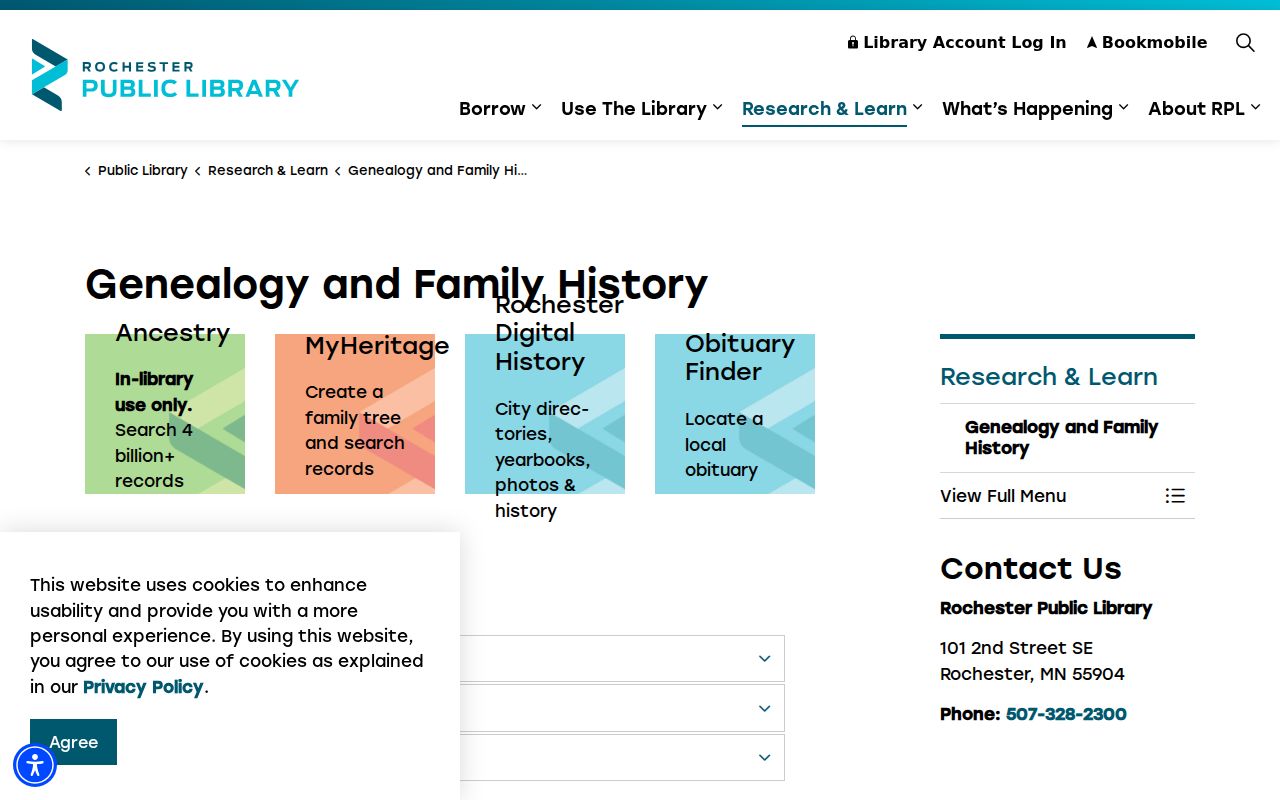
RPL's genealogy and family-history collection brings historical directories together with Rochester newspapers, Rochester yearbooks, cemetery and church categories, and online research tools. The Rochester local-history room is at 101 2nd Street SE. Its published local-history phone is 507-328-2309, and the library lists Monday through Thursday hours of 10 a.m. to 8 p.m. and Friday through Sunday hours of 10 a.m. to 6 p.m. A staff question should name the Rochester surname, address, approximate year, and whether an address index is needed.
The RPL genealogy page shows the local directory and historical research context used for a Rochester name or address search.
Library access also supplies Rochester companion evidence. Rochester papers run from 1859 through 1925 in the Minnesota Digital Newspaper Hub, and Rochester Post Bulletin microfilm begins in 1925. A Rochester directory result can be checked against a dated notice, obituary, or yearbook instead of being treated as a complete household record.
Rochester Directory Volumes in ResCarta
Rochester Digital History in ResCarta displayed 4,380 items when inspected. The public browse interface includes the Rochester directory collection alongside Rochester maps, obituaries, schools, Rochester history, postcards, fire-department material, and other local collections. Browse pages contain 48 items and can sort by title or publication date. This is useful when a Rochester surname is uncertain, because a researcher can begin with the relevant collection or use surrounding material to make the name more specific.
The ResCarta simple search has a search term, From and To date fields, collection checkboxes, and Clear All. It also exposes filters for creator, publisher, place, year, subject, geographic, and temporal terms. Dates belong to individual items, so a returned Rochester item should be cited by its own title and date. RPL indicates that Rochester Digital History is being refreshed in 2026; save a Rochester item's title and collection name as well as its link.
Rochester Directory Coverage Needs Staff Checks
No complete official list of Rochester city-directory publishers or annual coverage was found. The available Rochester evidence supports a careful method: identify the year needed, search ResCarta by title or date, then contact RPL if the Rochester edition, shelf location, reverse section, or scan quality remains unclear. The Rochester research record also does not establish a complete local run of reverse directories or telephone books. It is better to say that a Rochester address index needs confirmation than to promise that one exists for every year.
Reading a Rochester City Directory Entry
An actual Rochester entry must be read from the volume, because no local page image was captured in the research. When a Rochester scan is open, record the printed name exactly, then capture the rest of the entry before drawing conclusions. A Rochester directory may identify the person who answered at an address, while the assessor and deed system identify a taxpayer or title party. Those roles can overlap, but they are not the same claim. Preserve the Rochester edition year, page, street spelling, and every printed abbreviation.
| Printed name | Capture initials, spelling, and any spouse or household notation exactly as shown. |
|---|---|
| Occupation or business | Record the trade, business line, or employer wording only if printed in that local entry. |
| Street address | Keep the number, street name, quadrant suffix, and older spelling as printed. |
| Dwelling or owner notation | Record a marker only after checking that edition's abbreviation key. |
| Later phone notation | Copy it as a dated directory field, not as a current contact detail. |
- Criss-cross directory
- An address-order section that can lead from a street number to a listed historical occupant.
- Householder index
- A name-oriented listing that can help locate the main household entry for a given edition.
- Abbreviation key
- The volume's own explanation of shortened terms and symbols. Photograph or transcribe it with the entry.
Rochester Directory Records and Street Changes
Rochester adopted its quadrant system on July 9, 1918, with Broadway dividing east and west and Center Street dividing north and south. A Rochester directory may therefore use an older street name while modern Rochester property tools expect a quadrant suffix. The Rochester city history material links older SW names such as Main, Franklin, Prospect, and Grove to later numbered avenues. It also records a 1992 13th Avenue SW change in Rochester's Bamber Ridge Second Subdivision.
For an address trail, keep the street spelling from the historic volume, then compare it with the current and retired fields in county GIS, the parcel's legal description, and a plat if needed. The Rochester street directory has the modern parcel and address workflow. A name or number mismatch can be a street change, a renumbering, a parcel split, or a simple directory abbreviation.
Tracing Rochester Directory Households
A cross-year Rochester search is stronger than a single hit. Look for the nearest available edition, then compare entries on both sides of a move or disappearance. The 1849–1905 Minnesota census search available through Minnesota Historical Society is a useful historical household check, while a newspaper, deed, or obituary can narrow a move, death, or family connection. Each source should keep its role: a directory is a dated listing, a census is a snapshot, and a deed is a title record.
- Find the nearest verified Rochester edition for the name or address.
- Search surname variants, initials, spouse notation, occupation wording, and street address.
- Use a confirmed reverse or criss-cross section to check the same address and nearby numbers.
- Compare editions before and after the change, then pair the result with the relevant census period.
- Use newspapers, the obituary finder, a deed, or a probate record to test the reason for a changed listing.
A person disappearing from a directory may have moved, died, been omitted, appeared under another spelling, or remained at an address that was recorded differently. Do not label a gap as a move until a second dated source supports it. Note: The directory becomes more useful when every citation preserves its year, edition, page, address form, and the person's listed role.
Rochester Archive Help at HCOC
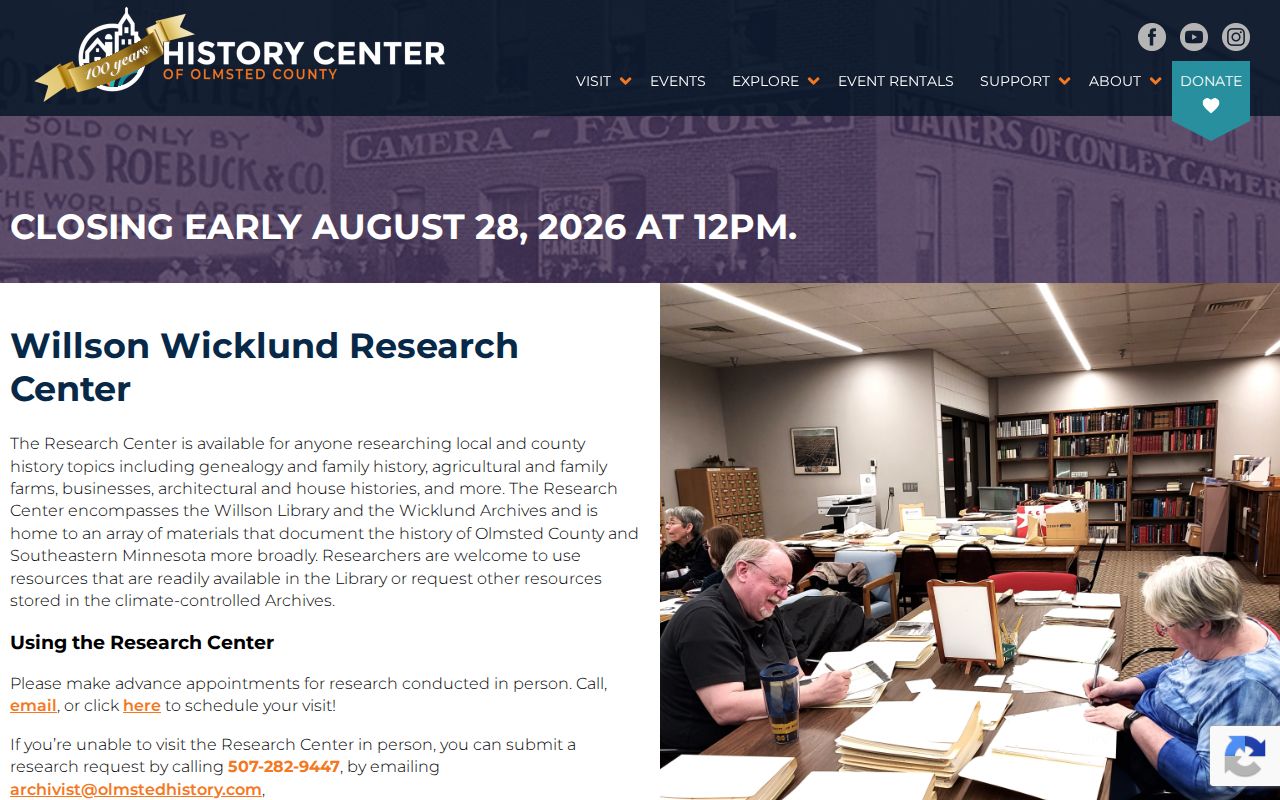
The Rochester HCOC Wicklund Archives accepts family, farm, business, architecture, and house-history questions. It asks for advance appointments and accepts remote Rochester requests by phone, email, or mail. Its published contact is 507-282-9447 and archivist@olmstedhistory.com. Send a narrow request with the historic and current Rochester address forms, a person or family name, an approximate period, and the question being tested. Staff research is listed at $25 per hour, with copy and handling fees also published.
The Wicklund Archives research page documents the Rochester archive route for house and family history.
HCOC's local stories give useful prompts without replacing a record. Dee Log Cabin, built in 1862 and moved six times, has a documented 1907 through 1911 resident interval. That kind of claim can be tested against a directory, map, newspaper, deed, and archive item rather than extended into an unbroken occupancy story.
Rochester Directory Dates and Sanborn Maps
A dated directory names or places people. A Sanborn map supplies the built context. Minnesota Historical Society's Rochester list includes editions from September 1884, June 1890, June 1899, June 1904, April 1909, June 1914, October 1920, and March 1928, plus a bound continuation from March 1928 through November 1948. The maps can show a building footprint, street layout, and use, but they do not list residents.
- 1884 through 1920: compare a directory address with the successive Rochester map editions.
- 1928 through 1948: check the bound continuation when an address or footprint appears to change.
- After a mismatch: retain the old street name and test it against the quadrant system, plat, and later parcel record.
MNHS's Sanborn list supplies the documented map dates. It is a separate historical index, so label its map evidence separately from the people named in a Rochester directory.