
Finding Rochester Residents by Record
Rochester has no official list of every person who lives in the city. Instead, each Rochester public system records a role. The Rochester assessor can identify an owner or taxpayer tied to a parcel. A Rochester deed connects people to a title transaction. The state voter tool confirms a registration match when the required details are known. Court, license, obituary, and archive records each answer still different questions. Treat the role and date as part of every Rochester result.
Start with the most specific fact. A Rochester address points to a parcel and its legal description. A name plus a date can narrow a Rochester court search or historical index. An old Rochester household is usually better pursued through RPL directories, newspapers, and census material than through a current assessment record. None of these sources promises an occupancy list, especially for people not named on title or in a historical volume.
- Search Olmsted iasWorld by address, owner, parcel, or map to establish the parcel and tax-record context.
- Use the state voter tool only for a known Rochester person and its required name, birth-date, and address inputs.
- Follow a title question through the recorder's LandShark index, preserving the legal description and document date.
- For a past household, check Rochester Public Library directories, newspapers, yearbooks, and the obituary finder.
- When a public portal lacks the needed record, request it from the proper custodian or use a courthouse, library, archive, or counter fallback.
Note: Keep a source date and record role beside each name, because a later search can otherwise turn an old lead into a false current claim.
Rochester Residents Records Custodians
Olmsted County splits Rochester land records among Property Records & Licensing, the assessor data system, and GIS. Recording & Abstracting maintains the Rochester recorded-document trail, while iasWorld presents current certified assessment data. The Rochester district court keeps court and probate files, and the county elections office handles local election administration. Rochester's City Clerk and Public Records Center are the correct route for many city-held records and permits. Selecting the Rochester custodian by record type saves a great deal of time.
Recording & Abstracting
151 Fourth Street SE
Rochester, MN 55904
507-328-7670
Olmsted Property Records
151 Fourth Street SE
Rochester, MN 55904
507-328-7670
Olmsted Elections
2122 Campus Drive SE, Suite 300
Rochester, MN 55904
507-328-7650
Address-by-address work belongs in the Rochester street directory, where the parcel, GIS, deed, permit, and historic-address chain can be kept separate.
Rochester Residents in iasWorld
iasWorld is the fastest Rochester county starting point when there is a street address, owner name, or parcel number. Its public interface offers Address Search, Real Property Search, Advanced Search, and Map Search. The county says the Rochester data reflect the last certified assessment date and are not warranted. That makes the result useful for a parcel, tax owner, situs address, mailing address, legal description, and value context, but not proof that every person at a Rochester address lives there now.
The Rochester property record distinguishes the physical situs from the tax-notice mailing address. Those fields can differ, and an owner may be a trust or entity. Record both labels rather than treating the mailing field as a residence. The property ID and legal description are particularly useful because they bridge a modern Rochester street address to deed, plat, and map research.
| iasWorld route | Use it for | Rochester caution |
|---|---|---|
| Address Search | A known parcel location | Try street variants when an old name is involved. |
| Real Property Search | Owner or property research | An owner is not necessarily an occupant. |
| Advanced Search | Documented combination-search route | The full live filter list was not captured. |
| Map Search | Parcel selection and nearby geometry | Map results are current property data, not household lists. |
Note: The portal's assessment snapshot is a useful starting date, not a promise that every displayed field reflects a current living arrangement.
Rochester Parcel Search in View
The Olmsted property search opens the county's address, real-property, advanced, and map routes. Start with a house number and street name, then compare the property ID, owner or taxpayer label, situs address, mailing address, and legal description before moving to another system.
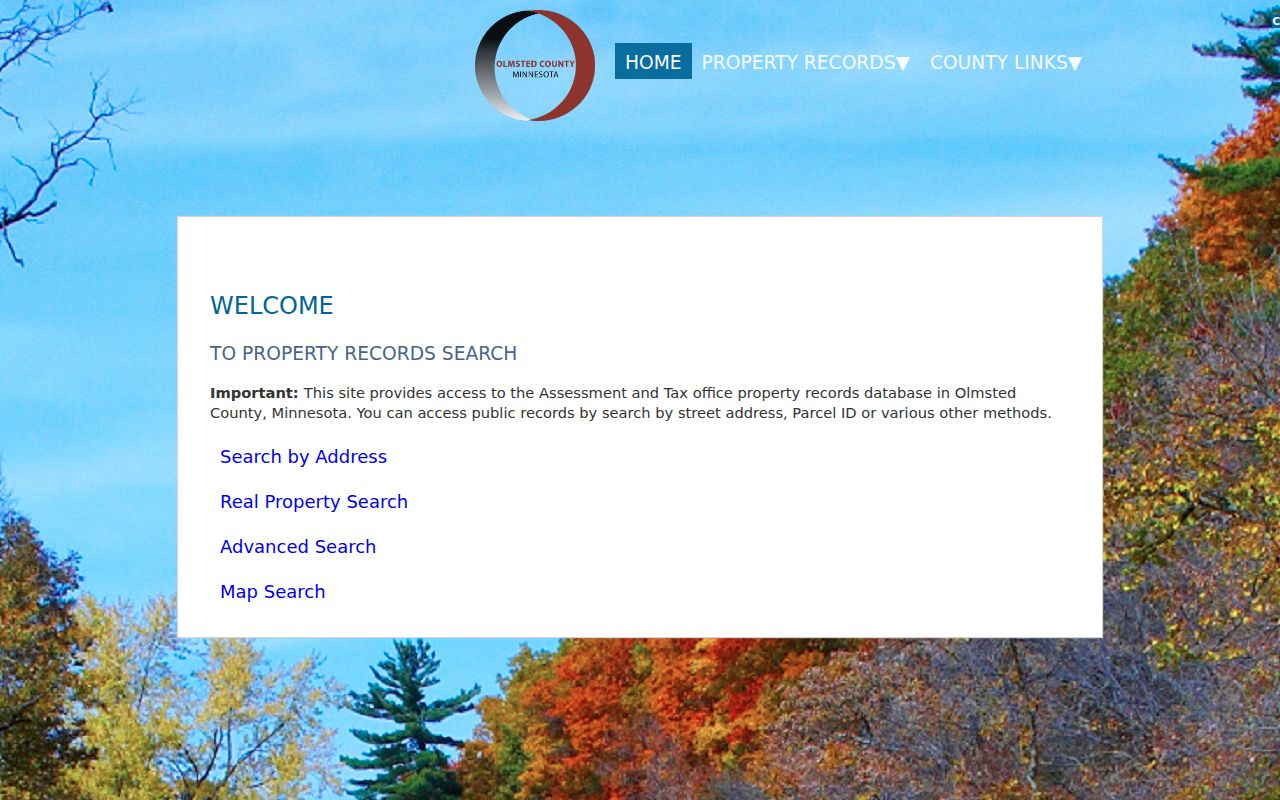
The screen confirms that Rochester property, address, real-property, advanced, and map paths are separate entries. That separation is helpful because a Rochester name trail, a parcel trail, and a map trail can each return a different but complementary piece of Rochester residents research.
Rochester Residents and the GIS Layers
Olmsted GIS adds the Rochester spatial layer that a property result alone cannot show. The public map and ArcGIS services include parcels, address points, street centerlines, city limits, zoning, districts, aerial imagery, and retired-address information. Map Search also exposes timing, distance, units, a choice of parcel center points or polygons, Select By Buffer, and a current-list return path. These tools are well suited to testing whether a Rochester street, parcel, or city-limit label has changed.
Rochester's retired-address layer is a local quirk worth checking when the modern address does not match a directory or deed. Keep old street labels and the current parcel/legal description together. A map can establish geometry and address continuity, but it cannot convert a parcel into a list of everyone inside it.
Rochester Resident Registration Checks
For a known Rochester individual, the Minnesota voter registration lookup asks for first and last name, full date of birth, and either ZIP or county-based address details. The Rochester county route also uses city or township, house number, and a selected street, with a conditional unit field. The data update nightly, and a new registration can take time to appear after processing. A no-result can reflect an input mismatch, timing, or protected status.
Minnesota Statutes section 201.091 controls public voter information. A person-specific web match is not a street-wide directory. The fuller list is limited by requester eligibility, permitted use, delivery controls, and restrictions on publication or sale. Protected voters can have information withheld, so never try to infer why a person is missing.
Minnesota's voter lookup visibly requires identifying fields and an address route before the search button becomes useful.
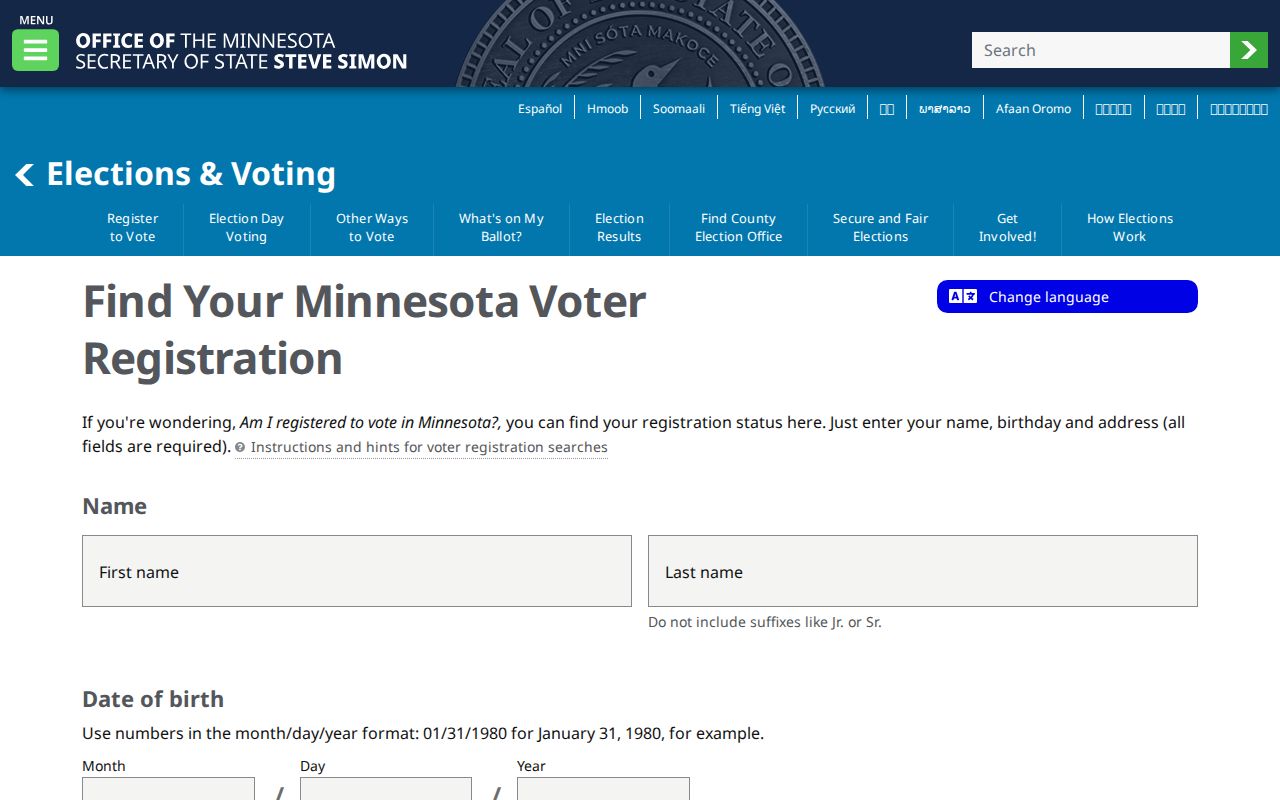
Use the displayed field rules to resolve an exact name-and-address question, not to turn the form into a broad resident roster.
Rochester Deed Names and LandShark
LandShark is Olmsted County's paid recorded-document research route for Rochester properties. Begin with the Rochester property owner and legal description, locate the purchase deed where that owner is the grantee, then search the seller as an earlier grantee. Recorded names can be grantors, grantees, trustees, or entities, so they show a title relationship rather than residence. The Rochester legal description matters when a subdivision, plat, or address changes.
The county documents separate subscription and occasional-user prices, billed detail pages and copies, staff research, and certified-copy options. It does not state a verified beginning year for the Rochester online index. When the electronic trail stops, ask Rochester Recording & Abstracting about older books and counter research instead of assuming the title trail ended. LandShark terms also prohibit data mining, mass downloading, resale, and alteration of Rochester index material.
- Parcel
- A county-defined piece of land used for assessment and mapping.
- Index
- A search aid that points to a record; it is not always the record image.
- Grantor and grantee
- The party transferring an interest and the party receiving it in a recorded instrument.
- Criss-cross directory
- An address-order directory section used to find historic occupants by street number.
Current Rochester Resident Directory Sources
Current Rochester resident clues are best read as a set of narrow records, not as one master directory. A Rochester property portal identifies tax and parcel relationships. Rochester voter registration confirms a constrained match. A Rochester court index reports a party role. License and business profiles show an affiliation or status. Rochester City permits can connect an application to an address. Each source needs a second clue before it supports a Rochester identity conclusion.
| Rochester source | What it can confirm | Custodian | Access limit |
|---|---|---|---|
| iasWorld property record | Owner or taxpayer, parcel, situs, mailing context | Olmsted County | Current certified assessment, not occupancy proof. |
| Voter registration lookup | Registration match and address-input status | Minnesota Secretary of State | Known-person inputs; protected records are withheld. |
| MCRO | Party role, case date, status, and public filings | Minnesota Judicial Branch | Unofficial and restricted by case type and date. |
| City Citizen Access | Permit or application connection to an address | City of Rochester | An applicant or contractor is not an occupant. |
| Professional and business records | Public credential or filing affiliation | State boards and Secretary of State | Do not treat an office or agent address as a home. |
When the task is to match one person carefully, a Rochester resident lookup follows the name-to-record workflow without turning a Rochester property, voter, or court hit into more than it proves.
Rochester Resident Court and Vital Trails
Minnesota Court Records Online, usually called MCRO, can search Rochester cases by person, business, attorney, case number, citation, hearing, or judgment. A common Rochester name should be narrowed by Olmsted location, filing date, case category, status, and any visible co-party or case number. The online Rochester result can show a case number, parties, category, filing date, status, register of actions, and available public documents. It deliberately hides some material, including public party street addresses and restricted case categories.
Rochester vital and historical indexes need the same care. Minnesota birth records are generally confidential for 100 years, while death informational records are public. The MOMS marriage index is searchable for participating counties, and Rochester divorce decrees come through the court that granted them. An index hit can guide an order, but it is not the same as a certified copy. Rochester's License Bureau and the state vital-record office are the ordering routes for their respective record types.
Rochester Resident Leads From State Lists
Minnesota's unclaimed-property search is a useful but narrow Rochester name lead. It accepts last or business name, first name, city, ZIP Code, or property ID. A Rochester match indicates an unresolved claim, not current residency. The state also offers official license lookups, such as the Department of Labor and Industry holder search, where a public credential can confirm a Rochester professional identity or status without suggesting a private address.
The DLI license lookup has holder and complete-number paths and publishes its downloadable license data nightly.
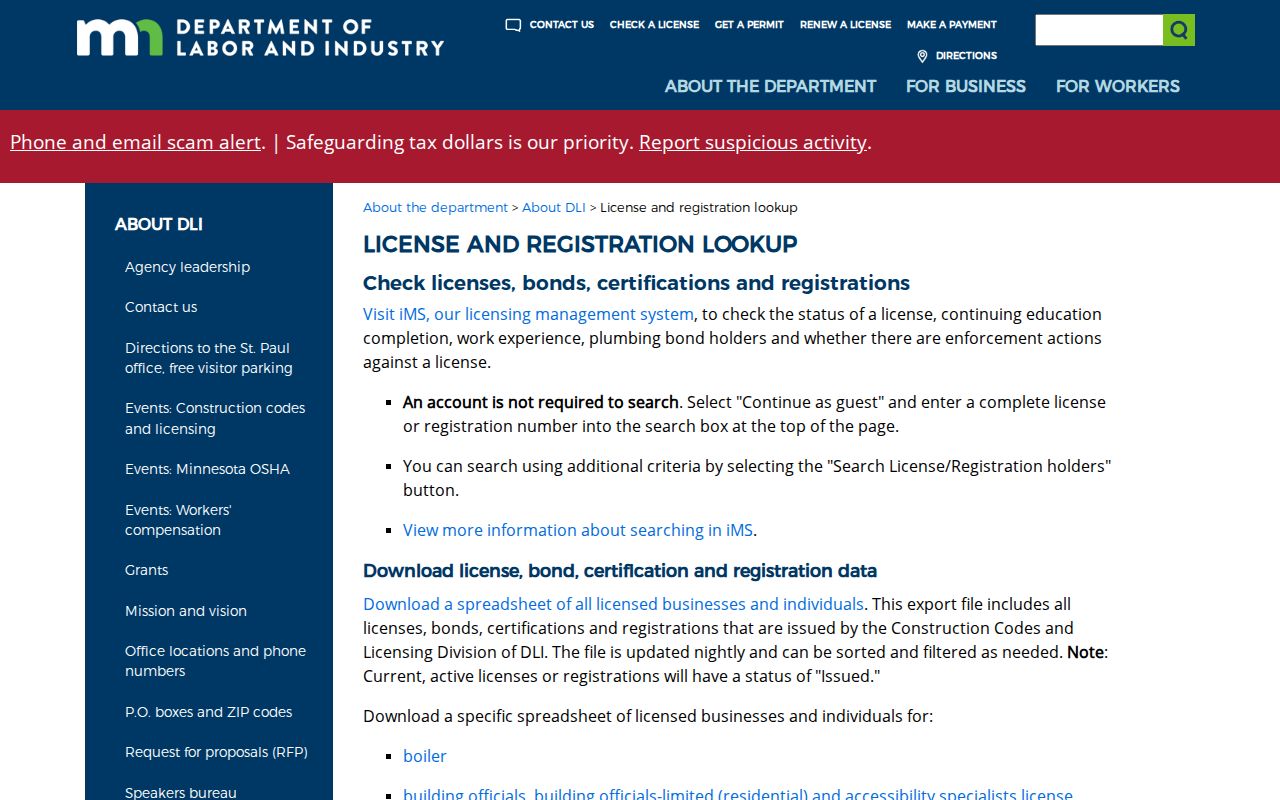
A license result is best labeled as a credential clue. It should be compared with its agency, status, city or ZIP field where visible, and record date rather than treated as a personal directory entry.
| Official record | Best use | Why it is limited |
|---|---|---|
| Government and archive indexes | Confirm a named role, event, or source date | Each has a defined scope and access rule. |
| Commercial compilation category | Possible lead requiring independent checks | Entries may be stale, merged, or inferred. |
| Custodian copy or terminal | Verify the record and request a certified copy when permitted | Fees, redactions, and eligibility can apply. |
Rochester Records Requests and City Files
The Rochester City Clerk's records route includes the Public Records Center, Laserfiche, Citizen Access, OpenGov, and Rochester City record categories that do not appear in a people index. Rochester Citizen Access permits anonymous searches of Building Permits, City Planning, City Licensing, and County Planning modules. A Rochester permit search can use permit number or, in address mode, building number and street name. A permit establishes a Rochester application, inspection, owner, or contractor connection, not who lived there.
Rochester's records page identifies the City's request and public-document routes.
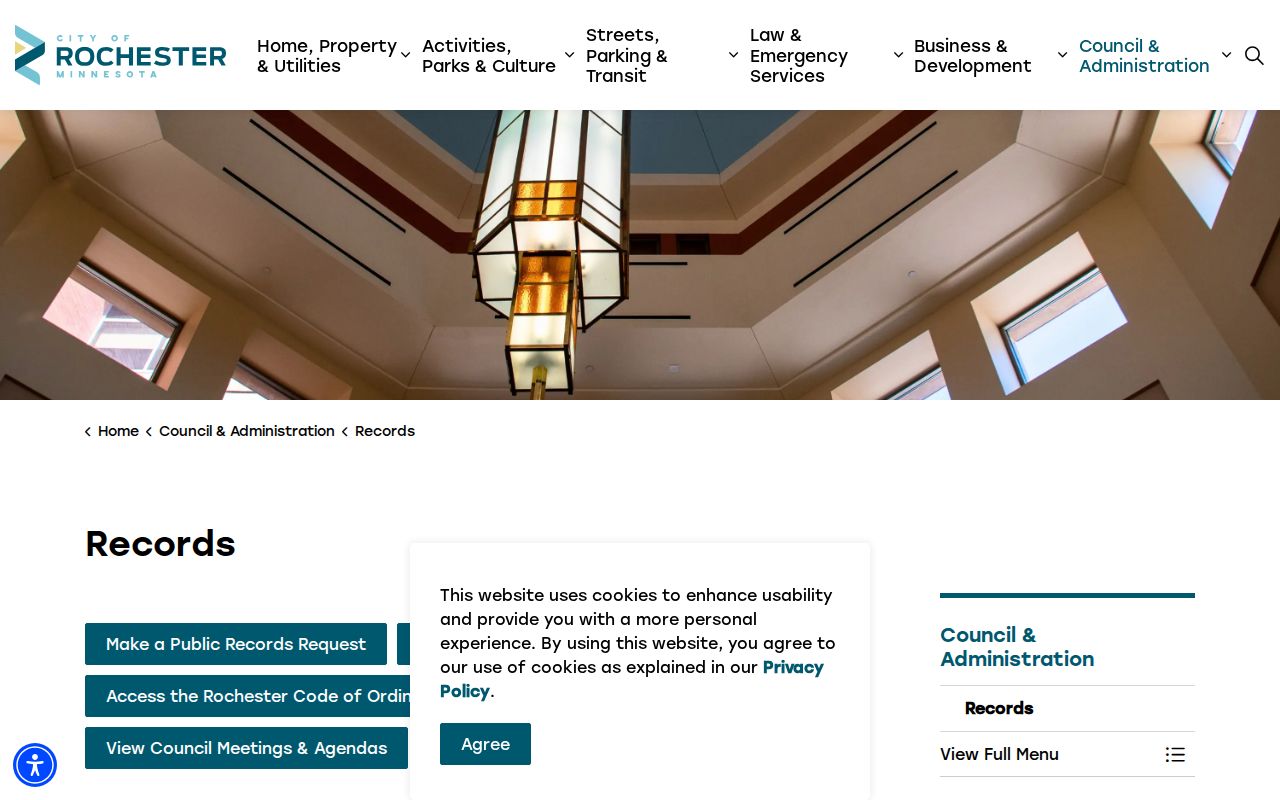
The Minnesota Government Data Practices Act starts with a public presumption but lets other law classify data as private. Inspection is generally free at reasonable times, and a request should describe the wanted record and custodian rather than ask for an undefined person search.
Historical Rochester Residents in Local Collections
Rochester Public Library is the Rochester starting shelf for old directories, obituary finding, newspapers, maps, yearbooks, cemeteries, churches, and local history. Its Rochester Digital History portal currently exposes ResCarta collections that include City Directories, Maps, Obituaries, schools, Rochester history, Post Bulletin material, and more. The Rochester portal can be searched or browsed by collection, title, creator, place, year, topic, and date range. Its individual collection coverage varies, so a Rochester result should keep its collection name and date.
RPL documents Rochester newspapers from 1859 to 1925 in the Minnesota Digital Newspaper Hub and Post Bulletin microfilm from 1925 forward. The exact complete local shelf run, publisher sequence, reverse-directory years, and last printed directory year were not located in the official material. Ask local-history staff for the specific edition and abbreviation key before making a claim from an unverified scan. The Rochester city directory holds the full collection and entry-reading method.
Rochester Directory Dates and Street Names
Historic Rochester addresses need a second timeline. Rochester adopted its quadrant system on July 9, 1918, with Broadway dividing east and west and Center Street dividing north and south. The Rochester street-name material ties several older names to modern quadrant naming. A Rochester directory, deed, or newspaper may therefore use an old street name that the current GIS will not recognize without a variant search.
Sanborn maps give the built-environment clock beside the name trail. Minnesota Historical Society lists Rochester editions for 1884, 1890, 1899, 1904, 1909, 1914, 1920, and 1928, plus a bound continuation through 1948. They can show a footprint, building use, and street context, but never a resident list. Pair the map date with a directory, deed, census, or newspaper instead.
Rochester Residents When Online Search Stops
A Rochester portal gap is not a dead end. The Rochester courthouse public terminals and Court Administration can be the right next step for an available court file. Rochester Recording & Abstracting can explain older deed books, copy options, and paid staff research when LandShark's documented online coverage is unknown. RPL's local-history room, the Olmsted County Historical Society Wicklund Archives, and Minnesota Historical Society finding aids cover different historical material and should not be treated as interchangeable.
For Rochester safety, an absence may have a lawful reason. Minnesota Safe at Home, protected-voter withholding, protected real-property data, restricted vital records, and limited court access all keep some information out of public Rochester results. Rochester official records are for personal, lawful research. Do not use a record or a missing result to stalk, harass, intimidate, or harm anyone.
Use the right custodian. A property, voter, court, library, or archive hit identifies a specific role and date; confirm it with the office or collection that keeps the record.