
Rochester Resident Lookup Evidence Map
A name is only a starting point. The strongest Rochester resident lookup matches a record to a narrow question: who holds title, whether a registration record matches, whether a court party is the same person, or whether a historical event is indexed. Rochester and Olmsted County records, Minnesota systems, and Rochester historical sources use different roles. An owner, taxpayer, registrant, court party, licensee, and obituary subject should never be treated as interchangeable labels.
| Record | What It Confirms | Where to Search | Access |
|---|---|---|---|
| Rochester property roll | Rochester owner or taxpayer, parcel, situs, and tax mailing context | Rochester iasWorld | Free current certified-assessment data; not occupancy proof |
| Rochester recorded deed | Rochester title parties, legal description, and recording trail | Rochester LandShark | Paid index, detail, and copy routes; online cutoff not located |
| Rochester voter registration | Rochester registration match after name, birth date, and address inputs | MNVotes | Free, nightly update; broader list use is restricted |
| Rochester court index | Rochester party role, case number, type, date, status, and public filings | MCRO | Free but unofficial; remote material is date and type limited |
| Rochester vital indexes | Rochester marriage or historical birth/death event clues | MOMS and MNHS People Records | Index access varies; certificates follow custodian rules |
Use an exact Rochester address to begin with the Rochester parcel or map record. Use a Rochester person who is participating in the lookup to begin with MNVotes. A Rochester case number is the best court key. For a historical Rochester question, the year and event type matter more than a loose name match. If the fact needs legal confirmation, ask the Rochester office holding the record about its copy procedure instead of treating a search result as final.
Match a Rochester Resident Across Sources
Rochester verification is a small matrix, not a single hit. Compare spelling, middle initials, age or birth date only where lawfully visible, Rochester address or ZIP, parcel ID, filing date, and co-parties. Narrow a Rochester search by Olmsted County and a date range. A person can appear in different Rochester systems for unrelated reasons, so retain the Rochester record role beside the name. A seller in a Rochester deed, for example, is not automatically the same person as a Rochester court party with a similar name.
- Write down the exact spelling, a Rochester city or county connection, and a date range from a record already in hand.
- Check Rochester iasWorld for an owner or taxpayer role, keeping the situs and tax mailing fields separate.
- Use Rochester MCRO with the county, date, and case-category limits, then compare case number, party role, and location.
- Use a relevant Rochester marriage, death, yearbook, or obituary index as an independent dated clue.
- Request a certified copy only from the Rochester office that keeps the record when an official copy is actually needed.
The sequence changes with the question. Rochester probate can be a careful route for an heir question because it may identify relationships, while a former-classmate trail in Rochester may properly stop at a yearbook or obituary. A no-result is also a result when the portal's Rochester coverage or privacy rule is recorded with it. That record of Rochester limits is part of a responsible Rochester resident lookup.
- Docket
- A court's running Rochester case record, often including filings, parties, events, and status.
- Index versus image
- A Rochester index points to a record. An image is the underlying document, which can be restricted or charged separately.
- Certified copy
- A copy issued by the Rochester custodian with its certification. It is different from an unofficial online display.
Check Rochester Court Records Carefully
Minnesota Court Records Online offers statewide case searching, including Rochester cases, and its Document Search uses a complete case number. A person search for Rochester can be narrowed by name, optional date of birth, filing date, status, category, and court location. Search a short name with the Rochester Olmsted location and a realistic date range. Wildcards follow at least two characters, while Sounds Like is an alternative tool rather than a second filter.
| Rochester MCRO input | Use in a Rochester check | Rochester limit |
|---|---|---|
| Last, first, middle | Start a Rochester person-name search and test a spelling variant | Same-name Rochester results need another matching fact |
| Date of birth or filing date | Reduce a broad Rochester result set | Optional and availability can vary |
| Court location and category | Focus on Rochester and Olmsted County for the relevant case type | Case classifications remain separate |
| Case number | Open a known Rochester case or its public documents | Document Search requires the complete number |
The MCRO Document Search screen shows the case-number field for Rochester and its Find Documents action. It is useful after a Rochester case number has been confirmed, not as a substitute for identity matching.
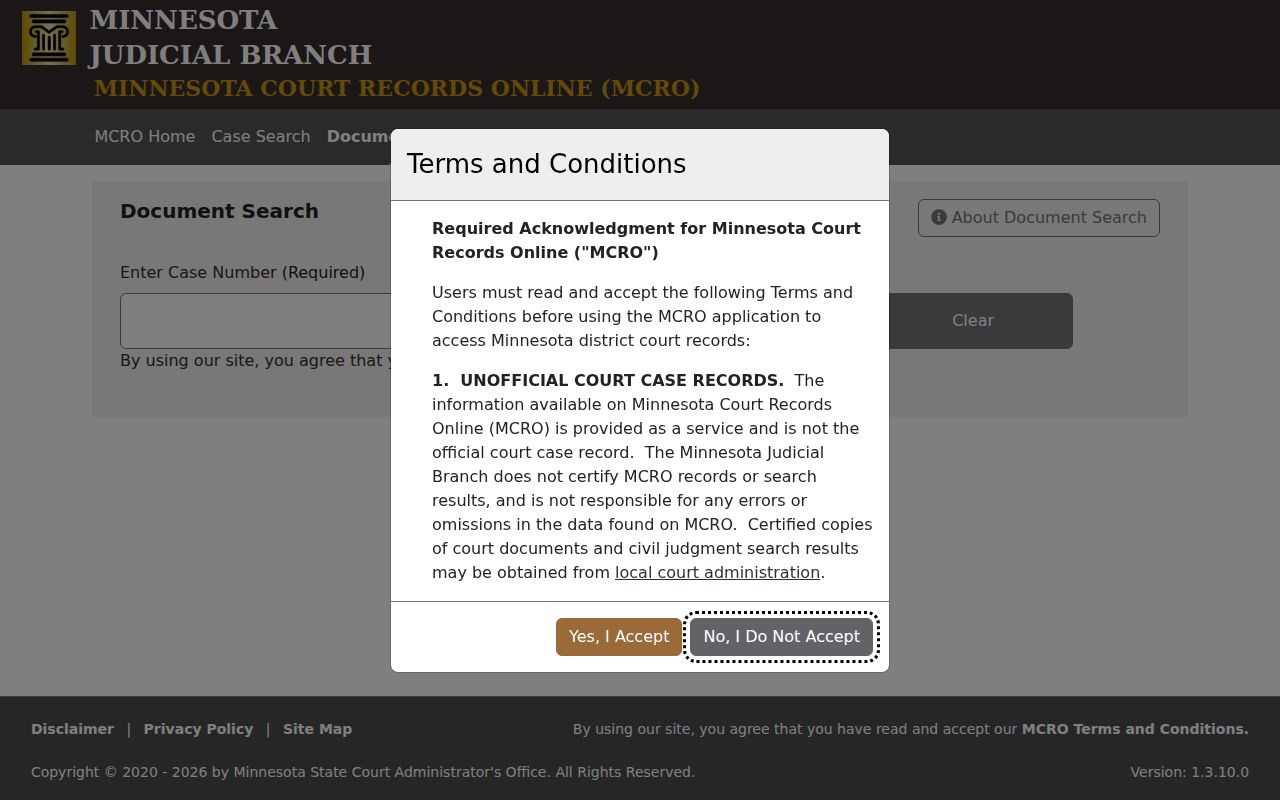
Public results for Rochester can show a case number, case type, parties, filing date, status, court, register of actions, and available public documents. Party street addresses and comment fields are hidden, and restricted material in Rochester cases such as juvenile, civil-commitment, and OFP/HRO records is not available remotely. For fuller public terminal access or a certified copy, contact Olmsted Court Administration in Rochester.
Compare Rochester Vital Record Paths
Vital records answer event questions, not a current-address question. Minnesota makes death informational records public, while birth records are generally confidential for 100 years under Minn. Stat. §144.225. That contrast is a useful Rochester resident lookup limit: an index entry can point to a life event without creating a right to every certificate or private field.
| Record path | Useful finding | Copy route and limit |
|---|---|---|
| MNHS birth and death indexes | Historical event and family-history clues | Coverage is collection-specific; early records need the right archive route |
| MOMS marriage index | Applicant names, county, and date-range match | Order a certificate from the county that issued the license |
| Olmsted License Bureau or MDH | Local or statewide birth, death, and marriage service | Eligibility and order rules vary by record type |
| District Court | Divorce decree or public court-file material | Classification and certified-copy procedure apply |
For birth or death ordering, the Minnesota Department of Health Office of Vital Records supplies state procedures. Olmsted's License Bureau provides local birth, death, and marriage service. A birth application requires the documented eligibility, identification, authorization, and notarization rules that apply to the request.
Use Rochester Voter Lookup Rules
MNVotes is a confirmation tool. It requires a known person's first and last name, date of birth, and address route, and it updates nightly. It does not give a public street-wide household list. A missing result can reflect an input error, a processing delay, protected status, ineligible age, or no registration, so it should never become a conclusion about whether someone lived in Rochester.
Broader voter information is governed by Minn. Stat. §201.091. The state request routes require requester certification and limit use. An eligible requester's full file is not a public web roster and should not be republished as one. Olmsted Elections can handle local registration questions through its official county contact route.
Note: A voter record confirms the status of a particular lookup, not every person connected with an address.
Sort Rochester Property Record Roles
iasWorld has Address Search, Real Property Search, Advanced Search, and Map Search. Its current certified-assessment data can identify a parcel, owner or taxpayer, situs, tax mailing address, legal description context, and value or tax context. The county disclaimer is important: the source is not warranted and its historic cutoff was not located in the official material inspected.
Owner, taxpayer, mailing destination, and physical situs are separate fields with separate meanings. A tax mailing address can be elsewhere, and title is not proof that a person lives on the parcel. If a legal-title question needs more depth, Recording & Abstracting's LandShark route can connect parties to recorded documents, but its images and detail paths are paid and the online start year is not stated. Keep the roles separate before drawing any conclusion.
Respect Rochester Resident Lookup Limits
The Minnesota Government Data Practices Act begins with public access but yields when another statute classifies data as private or nonpublic. Safe at Home participants use a designated address, and protected-voter procedures can withhold or substitute address information. Public property records may also have protections for vulnerable people. Do not try to reconstruct a protected person's location from a deed, tax mailing address, or partial result.
Lawful use. Rochester resident lookup results are for personal, lawful research and record verification. Minnesota's anti-stalking law, Minn. Stat. §609.749, prohibits using records to stalk, harass, intimidate, or expose another person.
Driver-license personal address data is restricted, utility customer information is not assumed public, and court or vital material can be limited even when an index exists. For a wrong record, ask its custodian for correction: Property Records & Licensing for property data, the elections office for voter information, Court Administration for docket issues, or the vital-record custodian for certificate matters.
End a Rochester Lookup at the Custodian
When a web index ends, choose the office or archive that holds the next record rather than filling a gap with inference. Olmsted Court Administration has public terminals and local-file access subject to classification. The Rochester Public Library has local history, yearbooks, obituary tools, newspapers, directories, and microfilm. Minnesota Historical Society research services and the Olmsted County Historical Society can help with historical collections that do not appear in a current portal. A resident lookup remains useful when it ends with a documented custody or coverage boundary.
A targeted request is more useful than a broad request. Give staff a full name, date range, record type, known case or document number, and the specific public record sought. Minnesota chapter 13 supplies the public-data request framework, but it does not require a custodian to release protected material. Record the response date and the source's stated coverage limit with the search notes.
Professional and business files can be affiliation clues rather than residence evidence. The Minnesota eLicense hub, DLI, or Secretary of State filings may verify a credential or an entity role, while a registered office remains a service address. That distinction keeps a one-person record trail accurate.